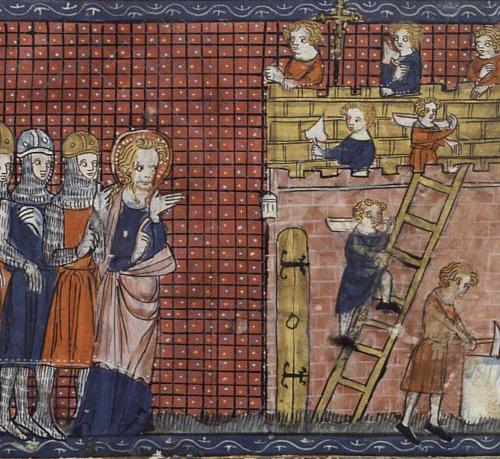
Saint Valentine of Terni and his disciples. 14th century France. Richard de Montbaston.
Saint Valentine's Day or Valentine's Day is on February 14. It is the traditional day on which lovers express their love for each other; sending Valentine's cards or candy. It is very common to present flowers on Valentine's Day. The holiday is named after two men, both Christian martyrs named Valentine. The day became associated with romantic love in the High Middle Ages, when the tradition of courtly love flourished.
The day is most closely associated with the mutual exchange of love notes in the form of "valentines." Modern Valentine symbols include the heart-shaped outline and the figure of the winged Cupid. Since the 19th century, handwritten notes have largely given way to mass-produced greeting cards. The Greeting Card Association estimates that approximately one billion valentines are sent each year worldwide, making the day the second largest card-sending holiday of the year behind Christmas.
Valentine's Day was probably imported into North America in the 19th century by British settlers. In the United States, the first mass-produced valentines of embossed paper lace were produced and sold shortly after 1847 by Esther Howland (1828-1904) of Worcester, Massachusetts. Her father operated a large book and stationery store, and she took her inspiration from an English valentine she had received. Since 2001, the Greeting Card Association has been giving an annual "Esther Howland Award for a Greeting Card Visionary."
In the second half of the 20th century, the practice of exchanging cards was extended to all manners of gifts in the United States, usually from a man to a woman. Such gifts typically include roses and chocolates. In the 1980s, the diamond industry began to promote Valentine's Day as an occasion for giving jewelry. (more)
In the second half of the 20th century, the practice of exchanging cards was extended to all manners of gifts in the United States, usually from a man to a woman. Such gifts typically include roses and chocolates. In the 1980s, the diamond industry began to promote Valentine's Day as an occasion for giving jewelry. (more)
(courtesy of wikipedia)


No comments:
Post a Comment